Dive Brief:
- California is considering a voluntary label verifying that foods are not ultraprocessed. The measure comes after the state set the first legal definition for the term last fall.
- Assemblymember Jesse Gabriel proposed a "California Certified" label for non-ultraprocessed foods. It would make California the first state to establish the verification program.
- While the label is optional for food makers, large grocery stores would be required to prominently display products carrying the non-ultraprocessed seal.
Dive Insight:
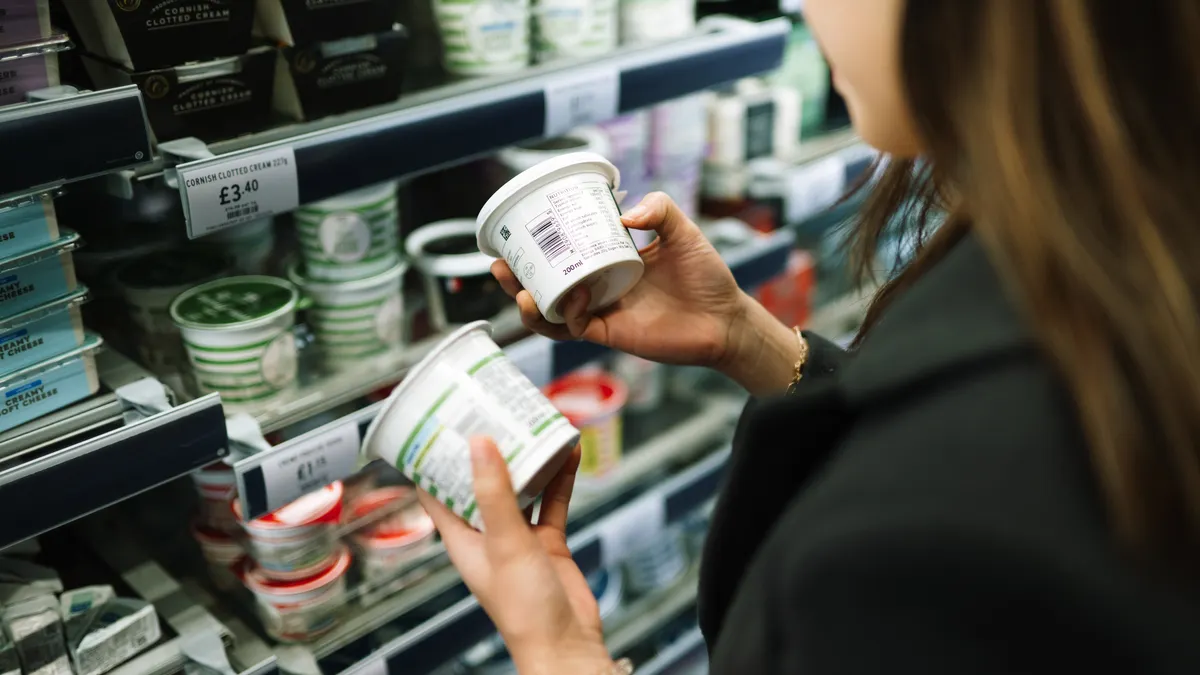
Modeled after the USDA Organic label, the state-verified seal is meant to quickly provide "consumers with a simple and trustworthy way to identify healthier options," said Gabriel, who was also behind a landmark California law that bans ultraprocessed foods from schools.
"This bill addresses the dangers of ultraprocessed foods, but it does it in a way that strengthens consumer choice, that drives innovation and that promotes healthier options across the food supply without banning any products," Gabriel said during a press conference.
California defines foods as ultraprocessed if they are high in saturated fat, added sugar or sodium. Ultraprocessed foods also contain a food additive such as flavor, color, emulsifier or a thickening agent.
Alyssa Moran, deputy director of the Center for Food and Nutrition Policy at the University of Pennsylvania, estimated that a third of packaged foods can be considered non-ultraprocessed under California's definition.
"There is a common misperception that without ultraprocessed foods, we'd either have nothing to eat or we'd have to scratch cook all of our meals," Moran said. "And that could not be further from the truth."
As more shoppers raise concerns around processed ingredients, the label could be a powerful driver of consumer purchases. The new verification program is meant to incentivize food companies to remove additives or reduce fat and sugar to qualify for the label.
California's bill is set to be debated in April with the goal of reaching the governor's desk by September, according to Gabriel.
As concern over ultraprocessed foods becomes a bipartisan issue, more states have moved toward banning certain ingredients or enacting labeling requirements that would tell consumers when foods are ultraprocessed. However, food companies have been successful in legal challenges to these laws, which has halted legislation in West Virginia and Texas.
California considered warning labels like those in Latin America, where foods high in sugar or saturated fat must have a black octagon on the front of their packaging, Gabriel said. However, he wanted to avoid a situation where every product in a grocery store aisle has "black octagons all over them," which would make it difficult for consumers to differentiate between products.
"We thought it would be a better way by acknowledging folks who are doing the right thing and who are creating products that are healthy," Gabriel said, "and that's actually information that would be most beneficial to consumers."
California is considering its own verification system as other third-party certifiers begin to offer their own voluntary labels with a different set of definitions.
The Non-GMO Project released a Non-UPF Verified Standard that will be used by brands including SpinDrift and Amy's Kitchen. Instead of focusing on ingredients, the Non-UPF Verified Standard looks at the level of processing and whether the structural properties of a food is changed through industrial manufacturing.